The business community influences the school culture and finances in many ways. For example the school I am from had 69 students who graduated and one of the neighboring schools graduated around 200 students annually. The differences between these two schools are not only their graduation number but their communities and the businesses that are in those communities are different and have different impacts on the schools. The smaller school has a small community where the major businesses around the area are family owned convenient stores and farms. This does not provide a lot of opportunities for the students in that community. The students do not have a local recreational center to go to so they can partake in organized activities. With the poor local business and low population there are not as many opportunities for local sport teams and out of season leagues. The bigger school is surrounded by a much larger community the businesses around this area range from local privately owned businesses to huge corporations such as Burger Kind and Wal- Mart. Also in this area there is enough money to afford local recreational centers that have indoor soccer fields and organized leagues that people can join and sign up for. The smaller community does not have the resources or income to give the same opportunities as the bigger community.
I do not agree with corporate funding of schools because I believe that public schools need to be funded by the community and a portion of that can be corporate but not enough for the corporate to have an omniscient role in that school community. If there were to be just strictly corporate funding in schools then that school will be ran to make money for that corporation, students will become advertisement property and instead of playing for a community the athletes and sports of the school would be representing a corporate company instead of a school and what the school means and represents.
If there were to be a place for corporate funding in schools the politics of that corporation would have to be set aside. The main purpose of the school is to educate and give children/ young adults the tools necessary to be successful in today’s society. That goes beyond contextual information and includes ethical, moral, and character values as well. No matter the business community surrounding a school whether it be small privately owned business or huge multi million dollar corporations the main priority should always be the student’s education.
Wednesday, May 9, 2012

Diveristy!!
Warren Peter Patterson
Section 2
Question 1
Diversity
From my standpoint diversity is the amount of culture and uniqueness that is brought into each classroom and lesson plan. When most people think of the word diversity they assume that people are usually talking about someone’s race or ethnicity, it also includes all stereotypes from cultural background, to religion, gender, social status, and educational level; all of these generalizations give labels to students that are unfair and detrimental to their learning.
Diversity does not just affect the students it also has an impact on the teachers as well. Each teacher is different along with each principal, school nurse, custodian, and all other faculty members that make up a school. On a personal level I come from a rural prominently white area, there are a few black families and that is it. The rest of our diversity in our community come from the social class, which includes where people live and how much money there family makes.
As a substitute teacher and completing over 75 plus field experience hours there were
some issues with students saying inappropriate generalizations about other students, for
example the term “throwing like a girl” is inappropriate because it is a subtle rude comment that indicate females cannot throw a ball or whatever the object was.
Personally I feel that students should be given many opportunities to express themselves individually in an educational setting. As physical educators it is our job to integrate what the students learn in other classes into our own lessons and own classrooms, this includes even outside the typical math, English, science into the other classes such as art and music. As physical educators we have the ability and opportunity to teach dance and listen to music while we teach therefore physical educators need to bring relevance to the music that is playing and bring the dancing to life with its history and positive background information.
Many games and new technology are helping bridge the gap between the integration of art and music into the PE setting. With games like DDR this allows students to stimulate themselves mentally with the video game however it also is keeping the student active and has them dancing and moving to beat with rhythm. Even though it is expensive the investment is well worth it not just for the students but for after school workshops for parents and other faculty members as well.
Section 2
Question 1
Diversity
From my standpoint diversity is the amount of culture and uniqueness that is brought into each classroom and lesson plan. When most people think of the word diversity they assume that people are usually talking about someone’s race or ethnicity, it also includes all stereotypes from cultural background, to religion, gender, social status, and educational level; all of these generalizations give labels to students that are unfair and detrimental to their learning.
Diversity does not just affect the students it also has an impact on the teachers as well. Each teacher is different along with each principal, school nurse, custodian, and all other faculty members that make up a school. On a personal level I come from a rural prominently white area, there are a few black families and that is it. The rest of our diversity in our community come from the social class, which includes where people live and how much money there family makes.
As a substitute teacher and completing over 75 plus field experience hours there were
some issues with students saying inappropriate generalizations about other students, for
example the term “throwing like a girl” is inappropriate because it is a subtle rude comment that indicate females cannot throw a ball or whatever the object was.
Personally I feel that students should be given many opportunities to express themselves individually in an educational setting. As physical educators it is our job to integrate what the students learn in other classes into our own lessons and own classrooms, this includes even outside the typical math, English, science into the other classes such as art and music. As physical educators we have the ability and opportunity to teach dance and listen to music while we teach therefore physical educators need to bring relevance to the music that is playing and bring the dancing to life with its history and positive background information.
Many games and new technology are helping bridge the gap between the integration of art and music into the PE setting. With games like DDR this allows students to stimulate themselves mentally with the video game however it also is keeping the student active and has them dancing and moving to beat with rhythm. Even though it is expensive the investment is well worth it not just for the students but for after school workshops for parents and other faculty members as well.
Bullying
Warren Peter Patterson
Section 2
Question 3
Bullying
Bullying is a serious issue that all students must face in one way or another in today’s schools. For students who are quite, not participate, unhappy, or even act out through aggression may all be signs of that student being bullied. Students today however have a new tool to use when it comes to bullying and that my friend is called the internet. The internet or cyber-bullying has really changed the face of bullying because now students go home and leave school and have to continue to face this humiliation at home. Many schools today including some in Tulsa have anti bullying programs that teach students about bullying and help them through stories and other educational activities.
The adolescent mind changes as students go form elementary school to middle school then on to high school. However going from elementary to middle school is a big step and many students have angst and feel pressure to do well from there peers, teachers and parents that they may not have felt before. Middle school students are maturing or going through the process of maturing and this is a crucial period for kids and it is important that teachers are helpful, informative, and always there to listen and ask questions. Students all mature at different levels and this gives more chance for bullying to occur. In Physical Education teachers have the opportunity to teach student how to defend themselves against bullies. The moral and principal of self-defense should be taught way before students learn the physical aspect of the karate. At SUNY Cortland physical educators are required to take a self defense class that focuses on lessons that address simple and basic escape maneuvers and tactics. The skills of self defense can be taught at all levels differently and teaches students how to be physically and mentally tough against bullies and the physical and mental harassment.
Section 2
Question 3
Bullying
Bullying is a serious issue that all students must face in one way or another in today’s schools. For students who are quite, not participate, unhappy, or even act out through aggression may all be signs of that student being bullied. Students today however have a new tool to use when it comes to bullying and that my friend is called the internet. The internet or cyber-bullying has really changed the face of bullying because now students go home and leave school and have to continue to face this humiliation at home. Many schools today including some in Tulsa have anti bullying programs that teach students about bullying and help them through stories and other educational activities.
The adolescent mind changes as students go form elementary school to middle school then on to high school. However going from elementary to middle school is a big step and many students have angst and feel pressure to do well from there peers, teachers and parents that they may not have felt before. Middle school students are maturing or going through the process of maturing and this is a crucial period for kids and it is important that teachers are helpful, informative, and always there to listen and ask questions. Students all mature at different levels and this gives more chance for bullying to occur. In Physical Education teachers have the opportunity to teach student how to defend themselves against bullies. The moral and principal of self-defense should be taught way before students learn the physical aspect of the karate. At SUNY Cortland physical educators are required to take a self defense class that focuses on lessons that address simple and basic escape maneuvers and tactics. The skills of self defense can be taught at all levels differently and teaches students how to be physically and mentally tough against bullies and the physical and mental harassment.
EDU 470 question 8
While being at Cortland I have had a wide variety of teachers ranging from hard raw old school teaching to a technologically based classroom setting and I could sit here for hours explain to someone how one of the styles are better than the other or in which class did I learn more in however regardless of how I learned they all had good teaching philosophies that at the end of the day taught students. Every teaching philosophy is unique and can have a lot of individuality to it and that is what makes a good philosophy being able to add a sense of individuality to your thoughts and teachings. The philosophies in the United States are essentialism, perennialism, progressivism, social reconstructionists, and existentialism. An essentialism approach has the idea to teach the students the absolute needs or the “essentials” to character development, academic knowledge, and patriotism. Perennialism come from a more context and factual approach, this kind of philosophy is structured around text books, and ideas and concepts. Progressivism is more of an authentic approach to the real world with primarily focusing their educational beliefs on the concerns, curiosity, and real life experience for the students. Social Reconstructionists relate to the students refining and “reconstructing” the justifications of society and are trying to teach to make society a better place for everyone. The last philosophy existentialism is very similar to one of Mosston’s styles of teaching which was self-teaching because both of these styles and philosophy deal with allowing students to find the answer to their questions and pretty much re-discover the wheel and all the mistakes along the way. Along with the mistakes they learn, the students also will learn the valuable lessons as well that go into “remaking the wheel”.
I am a firm believer in teaching through the physical and building character through physical education. I would have to categorize myself under the progressivism philosophy, I support the idea of being taught information that is relevant in today’s world. I like how progressivism wants to move away from the textbook material and get more hands on with the material.
My educational philosophy tells a lot about me as a teacher and what my goals are for the students. My goal is simple I want you to leave my class happy and a better more knowledgeable person. I want my students to truly learn and build their character through physical activity and by always challenging themselves physically and cognitively. Students should understand what it means to be responsible and respectful and that is where our roles as educators can have an impact on each student’s demeanor. This handout I made for my future Physical educational classes.
I am a firm believer in teaching through the physical and building character through physical education. I would have to categorize myself under the progressivism philosophy, I support the idea of being taught information that is relevant in today’s world. I like how progressivism wants to move away from the textbook material and get more hands on with the material.
My educational philosophy tells a lot about me as a teacher and what my goals are for the students. My goal is simple I want you to leave my class happy and a better more knowledgeable person. I want my students to truly learn and build their character through physical activity and by always challenging themselves physically and cognitively. Students should understand what it means to be responsible and respectful and that is where our roles as educators can have an impact on each student’s demeanor. This handout I made for my future Physical educational classes.
Sunday, April 22, 2012
Mann the man!!

One of the most important people in education is Horace Mann. He was the founder of common schools and helped to reinforce the foundation of education across the country. This “Father of the Public School” believed that public education work towards two goals that were practical and idealistic. In 1837 Mann held the position of “Superintendent” and had a hand in the creation of the Massachusetts State Board of Education. He strongly enforced improving education for all social classes. He believed that educating the working class would improve the economy by increasing the efficiency of industry and business. Mann thought that lower income families deserved the same amount of education as those who could afford it. One of the ways he did this was trying to desegregate the classrooms, but the role of religion proved to be an issue. He was not only a leader in education reform, a motivational force to his students. His focus in the classroom was not towards the typical content, instead he concentrated on relevant information that would prepare them for the real world.
In 1838, Mann created The Common School Journal. In it, he discussed the problems within public schools and what he believed in; “his six main principles were: (1) the public should no longer remain ignorant; (2) that such education should be paid for, controlled, and sustained by an interested public; (3) that this education will be best provided in schools that embrace children from a variety of backgrounds; (4) that this education must be non-sectarian; (5) that this education must be taught by the spirit, methods, and discipline of a free society; and (6) that education should be provided by well-trained, professional teachers. Mann worked for more and better equipped school houses, longer school years (until 16 years old), higher pay for teachers, and a wider curriculum”
Mann was a pioneer for all teachers in education and the public school system. He was one who stood up for what he believed in and made changes to better society through new age innovation and learning.
Playing with Polio

Thursday, April 19, 2012
Colonial Education
The nature and purpose of colonial education was different if you were a boy or girl. Christopher Lamb revolutionized the classroom, when Christopher Lamb was in school the program back then was focused around the bible and, moral and social values. The discipline during Christopher’s classroom experience was based off of physical punishment; the students received welts and bruises when they acted out. Christopher Lamb became a teacher after his apprenticeship was up, once he had the reins of the classroom he started to change things, for example he took out the need for physical discipline and began using a punishment and reward system. Education grew from simple home schooling to dames or stay at home mothers who started teaching more than just their own children. The education changed a little, yet the focuses were still on reading, religion, and values for the boys. However the girls were taught homemaking skills by the age of 7 years old. As time went on a law called Old Deluder Satan Law was passed and made it a requirement that –Every town of 50 households must appoint and pay a teacher of reading and writing, also – Every town of 100 households must provide a Latin grammar school to prepare youths for the university, under a penalty of 5 pounds for failure to do so. All in all the colonial time period for education laid out the foundations for, local control of schools, compulsory education, tax-supported schools, and state standards for teaching and schools. 

Tuesday, April 17, 2012
A little look at some history!
Tuesday, April 10, 2012
The Practice Method

Sunday, April 8, 2012
Non-Profit Soccer Organizations
Friday, April 6, 2012
Teaching philosophies
 While being at Cortland I have had a wide variety of teachers ranging from hard raw old school teaching to a technologically based classroom setting and I could sit here for hours explain to someone how one of the styles are better than the other or in which class did I learn more in however regardless of how I learned they all had good teaching philosophies that at the end of the day taught students. Every teaching philosophy is unique and can have a lot of individuality to it and that is what makes a good philosophy being able to add a sense of individuality to your thoughts and teachings. The philosophies in the United States are essentialism, perennialism, progressivism, social reconstructionists, and existentialism. An essentialism approach has the idea to teach the students the absolute needs or the “essentials” to character development, academic knowledge, and patriotism. Perennialism come from a more context and factual approach, this kind of philosophy is structured around text books, and ideas and concepts. Progressivism is more of an authentic approach to the real world with primarily focusing their educational beliefs on the concerns, curiosity, and real life experience for the students. Social reconstructionists relates to the students refining and “reconstructing” the justifications of society and are trying to teach to make society a better place for everyone. The last philosophy existentialism is very similar to one of Mosston’s styles of teaching which was self-teaching because both of these styles and philosophy deal with allowing students to find the answer to their questions and pretty much re-discover the wheel and all the mistakes along the way. Now the question is usually asked which philosophy is best and any good teacher will explain that no one philosophy is best however it’s the way the teacher can pull different meanings and lessons from each philosophy and bring that into their classroom and give the students more opportunities to learn. Click on me for the image

Tuesday, April 3, 2012
Do physical activity not drugs!
Drugs in schools are always an obstacle that students and educators must face. An article on Exercise and Substance Use Among American Youth found in the American Journal of Preventive Medicine by Yvonne M. Terry-McElrath discusses the relationship between drugs and student athlete’s performance in the classroom and exercise. The study shows how students who did not use drugs or alcohol including tobacco had higher grades and increase in exercise performance. The study also states that students who did use drugs and alcohol used less when they were exercising and participating on the athletic team. Seeing how substance abuse patients use exercise and physical activity to help control and decrease craving for their addiction, while students are using physical exercise to fill the need for drugs and alcohol. Now do not get me wrong rehab patients and high school athletes are completely different and are not directly related, but there is a connection between the physical activity and the drug use. As the reports show besides dealing with alcohol and high school students the drug use both decreased as physical activity increased. Many people get discouraged when they hear the words physical activity or physical fitness, however many activities that are lifelong healthy activities are recreational and fun, it is more than just going to the gym and working out. Activities such as hiking, kayaking, golf, tennis, or even dance are all healthy activities that can be used by anyone especially substance abuse patients. In many of the studies above athletics and physical activities took the place of using drugs and alcohol and have turned their physical activity into a new positive habit. (Picture)


Monday, April 2, 2012
Written Assessment!


Tuesday, March 27, 2012
Physical Activity Can Decrease Depression In Substance Abuse !!

Hoooper!!!

Sunday, March 25, 2012
An Introduction into Substance Abuse and Physical Activity
Everyday people are victims of substance abuse and it is a very difficult situation to overcome, however physical activity can help the process. Physical activity has many positive effects on individual moods and behavior so one can assume that it would also impact people with substance abuse problems in a positive manner as well and can help with the recovery process. The article Exercise preferences of patients in substance abuse treatment in Mental Health and Physical Activity by Ana M. Abrantes discusses the relationship between patients in substance abuse programs and physical activity. The research they conducted said that 71% of the patients were not regularly participating in physical activity however 95% of patients showed interest in programs that were exercised focused. Physical activity was shown to help with moods, self efficacy for abstinence, decrease the crave for using substances, and helps with the coping aspect of substance abuse. The programs have different opportunities for patients that range from walking to swimming to organized sports. I find this interesting because substance abuse is extremely serious and addicting, being able to use physical activity and exercise to help the recovery process is quite amazing. Having physical activity as a hobby is great way to deal with stressful situations and has many positive attributes that benefit patients even programs are over. Another great thing about using physical activity is that it is extremely flexible, for example, it can be done with or without others, inside or outside, in a small place or large place, and can be in expensive and still effective. !!!Keep checking my blog for updates on substance abuse and its relationship with physical activity!!! 
Reference
Abrantes, Ana M. "Exercise Preferences of Patients in Substance Treatmentabuse." Mental Health and Physical Activity 4.2 (2011): 79-87.

Reference
Abrantes, Ana M. "Exercise Preferences of Patients in Substance Treatmentabuse." Mental Health and Physical Activity 4.2 (2011): 79-87.
Friday, March 23, 2012
Post Assessing Dribbling at Newark Valley Middle School
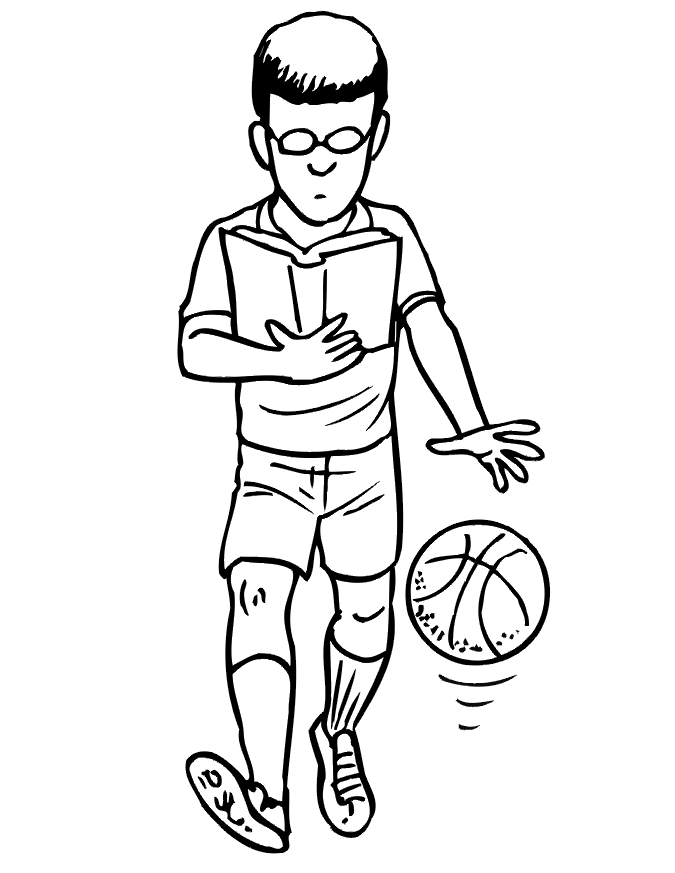 Today I went to Newark Valley Middle School to finish up our post assessment of dribbling and to observe a classroom. The classroom we observed was a 7th grade health class which had a guest lecturer and they discussed the term consequence and reputation. The discussions were very interesting and one response a student had for a good consequence was when someone eats they become full. I thought that was creative and funny for a 7th grader. The discussion for the reputation led to one student commenting that if someone were to steal or lie they would taint their reputation, I thought the vocabulary, using the word taint, was very impressive for a 7th grader. Once the health class was over we post assessed the same class we had Monday for the basketball skill dribbling. We warmed them up with some stretching in between the game Pac man Tag. The next activity was our post assessment which was a continuous dribbling game of knockout and when a person knocked out they went to the other area and every time they got knocked out they just kept going to the other area. After getting our post assessment data we asked our host teacher if we could let the kids go outside because it was such a nice day. So we went outside for the remainder of the period and played freeze tag with the class, however towards the end of class when we had to line up and go inside two girls who were sitting out did not behave. I looked over at them and saw one of them drop a stone and the other one put it in her pocket, I asked if she could put it down and she said it was for her boyfriend, my response was well it has to stay outside because we cannot bring stones into school. She ignored me and walked away so I informed my host teacher and she escorted the little girl to the office. The lessons we taught and saw today were well organized and ran pretty smoothly for being a Friday with elementary and middle school students.
Monday, March 19, 2012
Basketball Assessment
Today at Newark Valley Middle School my partner and I decided to our lesson focus on basketball dribbling skills and begin pre-testing them as well. Today as a whole I thought our class had a lot of fun because we were so enthusiastic and engaged with the kids. They were 5th grade girls playing simple dribbling games such as Dribble Blink where they basically have a staring contest while dribbling the ball, Traffic Light- speed dribble, walk dribble, or triple threat stance on the teachers cues Green light, Yellow light, Red light, and the last game we played was Dribble Knockout which was continuous because we used both sides of the court to make sure the kids were always playing. At first I was a little nervous playing these games with kids just because I thought they would feel too old and may not have fun with it however, I brought a lot of enthusiasm and had fun playing with them so I think that is why the games ran so smoothly. We pre-tested throughout the class while one of us was teaching the other was observing and assessing the students. Overall the skill level of the kids was at a competent level for being in 5th grade. It was obvious that some of the girls had experience with dribbling the ball versus some of the others that were at beginning stages of dribbling. There was improvement throughout the lesson, some girl who was struggling with dribbling with her head up in the begging was dribbling with her head up stationary by the end of class was participating in the blinking game and won! 
Sunday, March 18, 2012
Kan Jam!

Friday, March 16, 2012
Rules and Routines!!!
 Children can get out of hand in a hurry in the gym and in the classroom; this is where proper routines and rules should be in place. Having proper managerial procedures can help run a class much more effectively. One thing I learned when I was shadowing an elementary physical education teacher was to give directions in order and if they do not get that then simplify it more and give them the directions one at a time. For example if a group of students were given the directions to line up, put the equipment away, and be quite, the students may be confused and may be a little chaotic. The directions should go in an order such as put the equipment away, line up, and be quite, then students get the directions in an order and there is less confusion. Also try to limit student’s distractions, if students are playing with equipment when directions or instructions are being given can cause other students to lose focus and cause students to start chattering. On a personal experience I was explaining to 5th graders how to throw a Frisbee through a hula hoop, I was getting a little frustrated because with my loud deep voice I still felt I was continually talking over everyone, after my directions were given my host teacher pointed out that if the students put the equipment down (hula hoops) they will be less distracted. Reflecting on this scenario I agree if the students had the hoops on the floor they wouldn’t have been having a conversation about hula hooping.
Subscribe to:
Posts (Atom)